
CyberKreuz insight centre

News & Analytics

Organizational updates and evidence-based cybersecurity analysis.

UK Cyber Shield brings agentic AI into national cyber defence
News

UK Cyber Shield brings agentic AI into national cyber defence

The UK has outlined a new direction for national cyber defence that may become an important reference point for other European governments and large organisations. The National Cyber Security Centre and the Department for Science, Innovation and Technology published the Cyber Shield blueprint, describing it as a national-scale, collaborative approach to agentic cyber defence using frontier AI to identify, reduce and resolve national cyber risk.

Read more →
Brussels moves to close Europe’s AI-cyber defence gap
News

Brussels moves to close Europe’s AI-cyber defence gap

The European Commission has published a new Action Plan on Cybersecurity and Artificial Intelligence, setting out how the EU intends to prepare for a threat landscape in which cyberattacks, vulnerability discovery and defensive operations increasingly move at AI speed.

Read more →
ECB puts banks on the clock for AI-driven cyber resilience
News

ECB puts banks on the clock for AI-driven cyber resilience

The European Central Bank has given significant euro area banks a clear deadline to respond to the next phase of cyber risk. In a letter published on 7 July 2026, ECB Banking Supervision asked bank CEOs to submit comprehensive action plans by 31 October 2026 addressing AI-enabled cybersecurity threats.

Read more →
CyberKreuz Weekly Cyber Risk Intelligence Report - Week 27
Analytics

CyberKreuz Weekly Cyber Risk Intelligence Report - Week 27

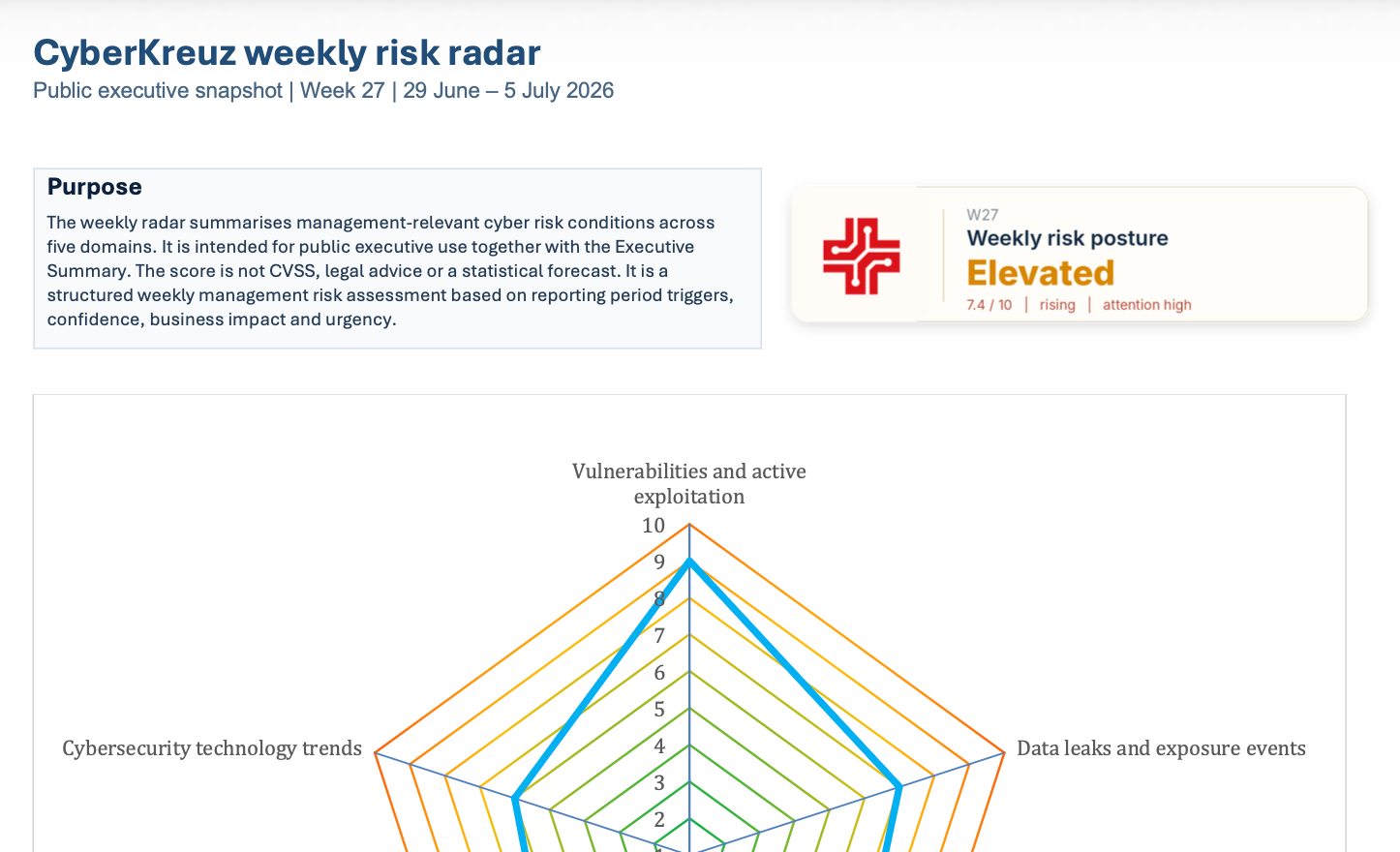
This week’s CyberKreuz weekly cyber risk posture is assessed as elevated at 7.4 out of 10 and rising. The reporting period was shaped by active exploitation of enterprise systems, continued data exposure through suppliers and managed environments, identity-based attack patterns, and a growing regulatory focus on operational resilience and evidence-based cybersecurity governance.

Read more →
Germany moves from cyber defence to active disruption
News

Germany moves from cyber defence to active disruption

Germany is preparing a fundamental change in the way it responds to cyber and hybrid threats. Under a draft reform reported this week, the country’s intelligence services could receive powers to penetrate hostile IT systems, manipulate or delete data, disable infrastructure used in foreign cyber campaigns and conduct targeted deception operations.

Read more →
US rebuilds public-private cybersecurity cooperation for critical infrastructure
News

US rebuilds public-private cybersecurity cooperation for critical infrastructure

The new ANCHOR-CI framework restores a formal channel between government and critical infrastructure operators after the previous partnership structure was abruptly terminated in 2025. Its success will depend not on the number of councils created, but on whether it can rebuild trust, exchange useful intelligence and turn discussion into coordinated action.

Read more →
China turns cybersecurity into a visible product rating
News

China turns cybersecurity into a visible product rating

A new national framework taking effect on 1 July introduces visible cybersecurity ratings for connected products. Although participation is voluntary, the scheme could influence procurement, consumer trust and market access far beyond its initial product categories.

Read more →
Cyber conflict continues even when military operations pause
News

Cyber conflict continues even when military operations pause

Israel recorded approximately 4,800 hostile cyber incidents during June 2026 - three times the number reported during the corresponding conflict period in 2025. Critical infrastructure has reportedly remained protected, but smaller organisations have suffered destructive attacks, demonstrating why cyber risk does not disappear when military operations pause.

Read more →
Apple breaks its patch cycle as AI shrinks the time to exploit
News

Apple breaks its patch cycle as AI shrinks the time to exploit

Apple has released security fixes earlier than planned because artificial intelligence is reducing the time attackers may need to turn disclosed vulnerabilities into working attacks. The decision is an important signal for every organisation still managing cyber risk according to monthly or quarterly patching routines.

Read more →