
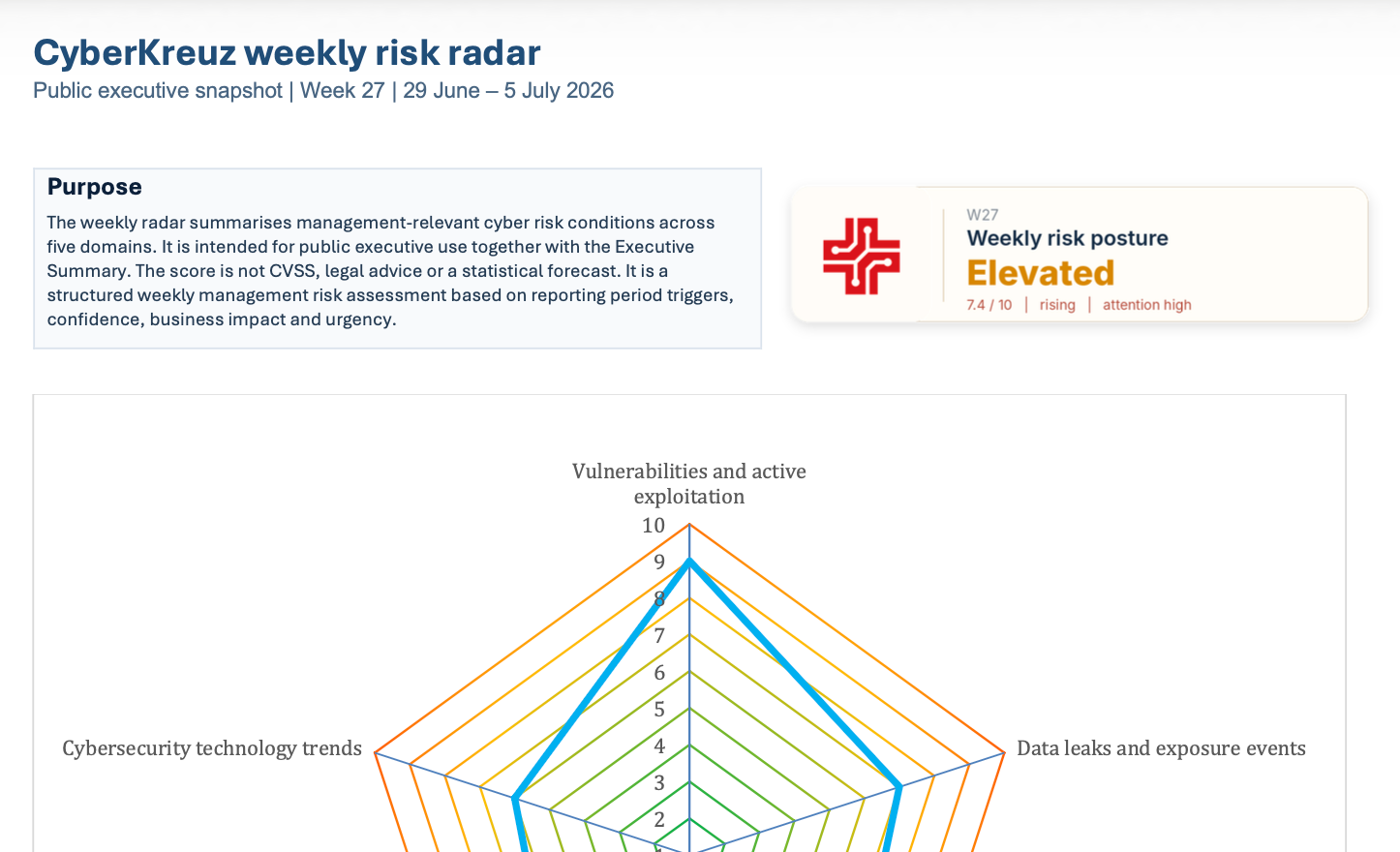
The strongest immediate risk came from vulnerabilities affecting business-critical platforms, including collaboration systems, unified communications, ERP/payment environments, product lifecycle management platforms, endpoint security components, Linux infrastructure and AI developer tools. For security leaders, the priority is not only to confirm whether patches are available, but to validate whether affected systems exist, whether they are exposed, and whether compromise may already have occurred before remediation.
Data exposure remained a major management concern. The week included significant breach and exposure events across insurance, healthcare, telecommunications, automotive, manufacturing, public-sector and managed-service environments. The Singapore Land Authority / IBM case was especially relevant as a governance signal: real personal data in a testing environment can create material privacy and supplier-risk impact even when live production systems are not compromised. This reinforces the need to include development, testing, analytics and vendor-managed environments in data-protection oversight.
Threat activity continued to move beyond traditional malware and patching issues. Identity abuse, token misuse, password spraying, residential proxy infrastructure, help-desk social engineering, malicious proof-of-concept repositories and AI-assisted attack workflows all appeared as current-week risk signals. The common pattern is clear: attackers are exploiting trusted workflows, not only technical vulnerabilities. This makes identity monitoring, service-desk verification, developer-tool governance and AI-system inventory increasingly important for CISOs and boards.
European regulatory and policy developments also continued to build pressure. Dutch NIS2 implementation moved closer to final adoption, ENISA launched the next NIS360 assessment cycle, the EU Cybersecurity Skills Coalition EDIC was established, EDPB and AMLA announced work on financial-crime information-sharing guidance, and the UK Cyber Security and Resilience Bill remained relevant for European suppliers serving UK essential services. The management implication is that cyber compliance is becoming more evidence-driven, more operational and more closely linked to supplier assurance, workforce capability and executive accountability.
Technology trends this week pointed toward a more mature cyber operating model. AI agent security, identity-defined reachability, runtime-aware application security, post-quantum cryptography readiness, AI-assisted SOC architecture, collaboration-bot governance and AI control-mapping validation all indicate a shift from isolated tools toward continuous evidence, controlled automation and measurable risk reduction. Organisations should avoid adopting these technologies as disconnected products. Their value depends on governance, ownership, validation, integration and clear success criteria.
For the next week, management attention should focus on three areas: closure status for critical vulnerability exposure, supplier and data-leak relevance screening, and regulatory milestones linked to NIS2 and AI governance. Boards should request concise evidence of action, not generic cyber status updates. The most useful questions are whether the organisation knows its exposure, whether compromise checks were performed, whether critical suppliers were screened, and whether ownership exists for the regulatory and technology signals that may affect the business.
Full PDF report
The full Analytics PDF report is available to active CyberKreuz members. The article, abstract, image and public PDF brief remain available on this page.
Log inBecome a member