
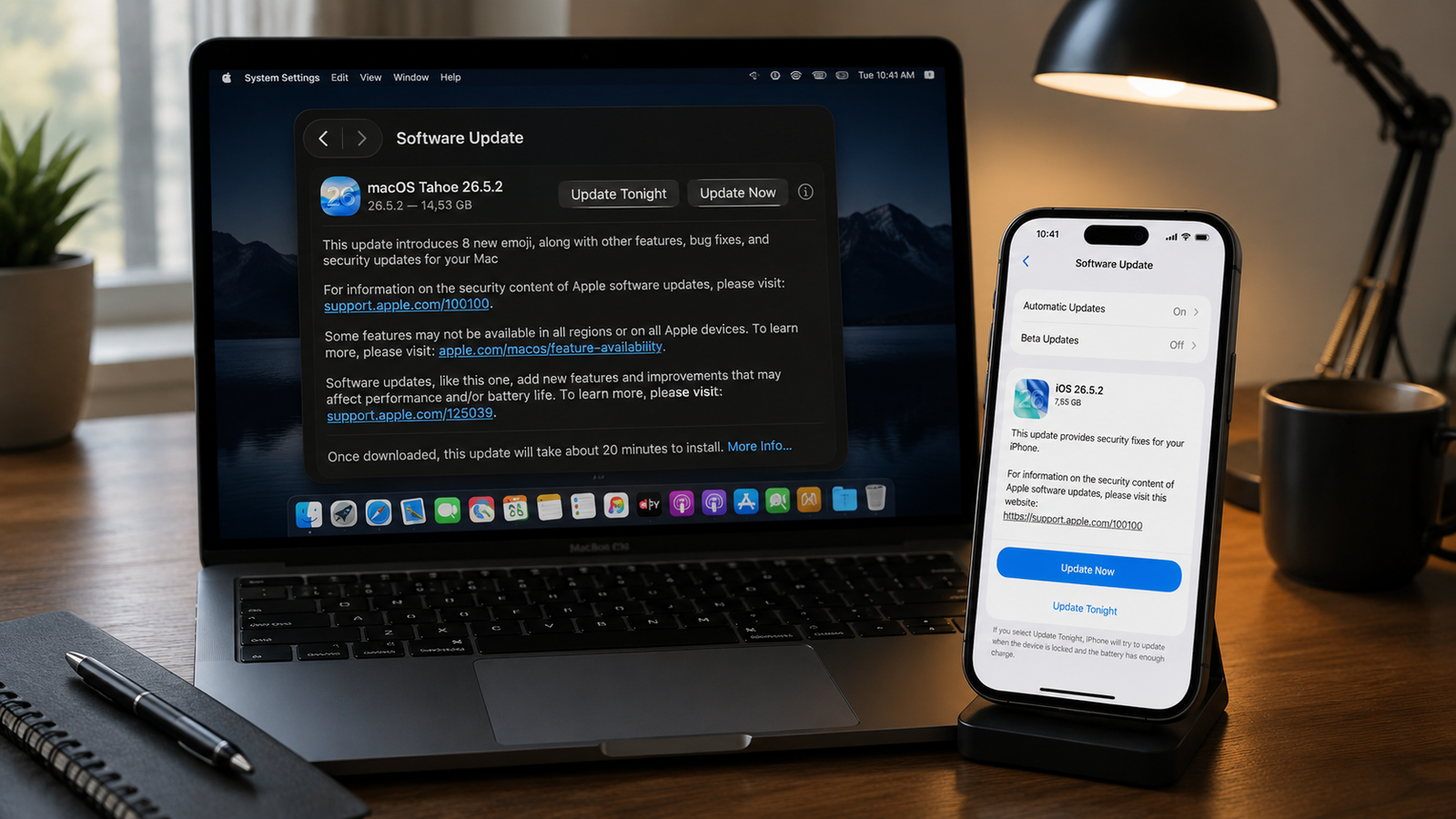
Apple has changed its normal software-release process and issued a collection of security fixes before the broader operating-system updates in which they were originally expected to appear.
On 29 June, the company released iOS 26.5.2, iPadOS 26.5.2, macOS Tahoe 26.5.2 and Safari 26.5.2. The fixes had previously been included in beta versions of iOS 26.6, iPadOS 26.6 and macOS Tahoe 26.6, but Apple moved them into generally available updates instead of waiting for the complete 26.6 release cycle.
Apple told Reuters that the change was a response to the increasing ability of AI systems to accelerate the development of malicious hacking tools. The company concluded that it needed to shorten the period between security fixes becoming visible and those fixes reaching customers’ devices.
There is currently no evidence that the vulnerabilities addressed in these updates were already being exploited. Apple’s decision was therefore preventive rather than a reaction to a confirmed active attack.
That distinction is important. Apple is not responding to a single emergency. It is adjusting its security operating model because the underlying speed of vulnerability research and exploit development is changing.
Why Apple released the fixes early
Apple normally combines many security corrections with broader operating-system releases. A new version is distributed to developers and beta testers before the stable update becomes available to the general public.
That process provides time to test compatibility, identify bugs and reduce the risk that an update disrupts customers’ devices. It also creates a period during which changes incorporated into a beta release may be examined before all production devices have received the corresponding protection.
Apple’s concern is that AI can compress this period.
Security researchers and attackers can study software changes, compare different builds, identify where protections were added and investigate what weakness a change was intended to correct. AI-assisted tools can accelerate several parts of that process, including code analysis, vulnerability discovery, crash investigation and the construction of potential exploitation paths.
Apple did not say that the latest vulnerabilities had been weaponised. Its position is that the previous timetable now creates more exposure than the company is prepared to accept.
The practical result is a separation of security delivery from the normal product-release calendar: customers receive the protection now, while the remaining features and changes planned for version 26.6 continue through testing.
What the updates address
Apple’s security advisory for iOS 26.5.2 and iPadOS 26.5.2 lists 37 CVE identifiers affecting components including the operating-system kernel, graphics processing, WebKit, web extensions, WebRTC and the libxslt processing library.
The possible consequences described by Apple include:
- writing to or corrupting kernel memory;
- leaking sensitive kernel information;
- extracting information across website security boundaries;
- disclosing process memory or other sensitive user data;
- processing restricted web content outside the intended sandbox;
- silently manipulating clipboard data;
- causing Safari or system processes to crash.
Several of the most consequential issues are associated with WebKit, the browser engine used by Safari and embedded web content across Apple platforms. Apple’s advisory includes flaws that could permit malicious websites to extract cross-origin data, expose sensitive information, cause memory corruption or process content beyond normal sandbox restrictions.
The same security corrections were included in macOS Tahoe 26.5.2. Apple also issued Safari 26.5.2 for Macs running macOS Sonoma and macOS Sequoia, extending many of the browser-related protections to systems that have not moved to the latest macOS generation.
The affected mobile-device range includes iPhone 11 and later, together with supported generations of iPad Pro, iPad Air, standard iPad and iPad mini.
AI is already present on both sides of the vulnerability race
The release notes contain another important detail: AI systems are not merely the reason Apple is accelerating its response. They also contributed to the defensive discovery of some of the vulnerabilities being corrected.
Apple’s acknowledgements explicitly reference researchers working with:
- Anthropic’s Claude;
- OpenAI Codex Security;
- Z.ai’s GLM;
- NVIDIA’s AI Red Team.
One WebKit memory-corruption vulnerability was credited to researchers working “with Claude, Anthropic.” Other entries acknowledge OpenAI Codex Security for identifying WebKit issues, researchers using GLM from Z.ai, and NVIDIA’s AI Red Team.
This illustrates the dual nature of the change.
AI can help software vendors and legitimate researchers discover vulnerabilities earlier, review more code and validate fixes faster. The same general capabilities can also help hostile actors analyse patches, explore attack paths and automate parts of exploit development.
The competitive question is therefore no longer whether defenders or attackers will use AI. Both will. The more important question is which side can convert information into action faster.
A five-day macOS exploit demonstrated the changing speed
Apple’s decision also comes after researchers demonstrated how an advanced AI model could materially accelerate vulnerability research against Apple’s own security architecture.
In May, researchers from Calif described using Anthropic’s Mythos Preview to construct a working macOS kernel privilege-escalation chain targeting Apple’s M5 platform. The research reportedly combined two vulnerabilities and several techniques to move from an unprivileged local user to root access while Memory Integrity Enforcement was enabled.
Memory Integrity Enforcement was designed to make memory-corruption attacks substantially more difficult. According to the researchers, the AI-assisted work produced a functional exploit chain within five days.
This does not mean an autonomous AI system independently attacked Apple devices, nor does it establish that ordinary criminal groups can immediately reproduce the same result. The work involved skilled security researchers, controlled access to a specialised model and substantial human direction.
It nevertheless demonstrates how advanced AI can amplify expert capability and reduce the time required for work that previously involved far more manual analysis.
The strategic significance goes beyond Apple
Apple’s change should be understood as an early response to a broader shift in vulnerability economics.
For many years, enterprise patching programmes balanced two competing risks:
- the security risk of leaving a vulnerability uncorrected;
- the operational risk that a rushed update might disrupt applications, devices or business processes.
This trade-off has not disappeared. Updates still require testing, deployment planning and recovery procedures.
What has changed is the speed at which the first risk can grow.
A vulnerability that once required weeks of specialist investigation may become actionable much sooner when capable AI systems assist with code review, root-cause analysis and exploit construction. The traditional assumption that organisations have a comfortable testing period after a security update becomes public is increasingly unsafe.
Apple’s action is particularly significant because it comes from a vendor that controls the hardware, operating system, update infrastructure and much of the application ecosystem around its devices. Even with this high level of vertical integration, Apple has concluded that its release process must move faster.
Companies with fragmented infrastructure, multiple software suppliers and slow internal approval chains face an even greater challenge.
What this means for enterprise patch management
The immediate lesson is not that every update should be installed everywhere without testing. It is that fixed patching schedules should give way to risk-based deployment decisions.
1. Security updates should not wait for normal maintenance cycles . A monthly maintenance window may remain suitable for routine changes, but it should not automatically determine when high-value security fixes are deployed. Organisations need a separate emergency or accelerated pathway that can evaluate and release critical updates within hours or days.
2. Long deferral periods need to be reconsidered. Apple’s enterprise-management framework allows organisations to defer software updates for between one and 90 days. This provides time for compatibility testing and staged deployment, but a default 30-, 60- or 90-day delay may create excessive exposure when AI-assisted analysis can shorten the path from patch publication to exploitation. Deferral should be a deliberate risk decision, not an inherited configuration that continues indefinitely.
3. Beta exposure must become part of vulnerability intelligence. Security teams should monitor not only final vendor advisories, but also beta releases, researcher disclosures and changes introduced into preview software. When security-related changes appear in beta code, organisations should assume that competent researchers and adversaries may already be analysing them.
4. Managed Apple devices should have enforceable deadlines. Apple’s declarative device-management capabilities allow organisations to specify a required operating-system version and an enforcement deadline. Managed devices can download and prepare the update in advance, notify users and complete installation by the specified date. For corporate Apple fleets, merely informing users that an update is available is no longer sufficient. Organisations need evidence showing:
- which devices are affected;
- which devices have installed the update;
- which devices remain exposed;
- when installation will be enforced;
- what exceptions have been approved and by whom.
5. Browser components deserve the same priority as operating systems. Many of the vulnerabilities corrected in this release affect WebKit and related web-processing components. A user may encounter hostile content simply by visiting a malicious or compromised website. Organisations should therefore treat browser and web-engine updates as core security controls rather than ordinary application maintenance.
Questions boards should ask
Boards do not need to manage individual CVEs, but they should understand whether their organisation’s vulnerability-management process reflects the new threat velocity.
Relevant questions include:
- How quickly can we deploy an urgent update across employee and executive devices?
- Do our patching targets measure the time from vendor release to actual installation?
- How many devices remain outside central management?
- Are security updates delayed by the same testing process as feature upgrades?
- Can we enforce installation, or do we rely on employees to update voluntarily?
- Are suppliers and outsourced service providers subject to equivalent patching expectations?
- Have our remediation targets changed to reflect AI-assisted vulnerability discovery and exploitation?
The board-level metric should not simply be the number of vulnerabilities closed during a quarter. It should include the organisation’s exposure window: the time between a fix becoming available and the last relevant production system becoming protected.
Speed must not eliminate control
Accelerated patching does not justify abandoning testing or change management.
A defective update can still disrupt business operations. Organisations should therefore improve the speed and quality of their deployment pipeline rather than bypassing it.
A mature process should include:
- a representative test group;
- automated compatibility checks;
- staged deployment;
- rapid rollback or recovery procedures;
- executive escalation for overdue high-risk devices;
- verified reporting from device-management platforms.
The objective is controlled speed.