
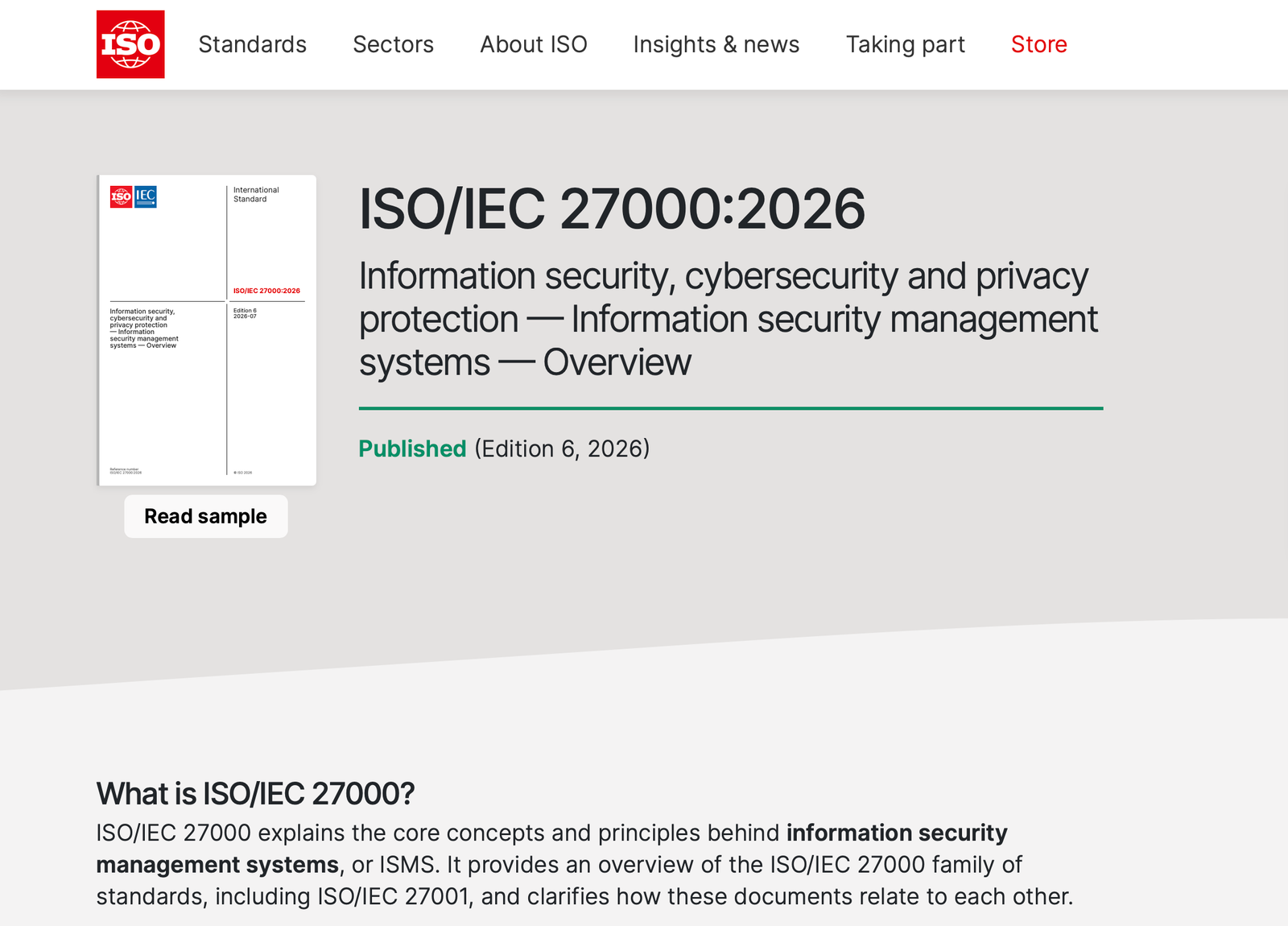
The release may look modest at first sight. ISO/IEC 27000 is not the certifiable standard that organisations usually reference in contracts, audits and certification programmes. That role remains with ISO/IEC 27001:2022, which defines the requirements an ISMS must meet. But ISO/IEC 27000 plays a different and important role: it explains the concepts, principles and relationships behind the ISO/IEC 27000 family of standards.
This makes the 2026 edition strategically relevant for CISOs, compliance leaders, auditors, consultants and board-level risk owners. It does not create a new ISO 27001 certification obligation. It does not mean that companies certified to ISO/IEC 27001:2022 suddenly need to recertify. But it does update the conceptual foundation that many organisations use to explain, document and govern information security management.
The International Electrotechnical Commission lists ISO/IEC 27000:2026 as an International Standard with a publication date of 3 July 2026 and edition 6.0. ISO’s own page shows the new edition as ISO/IEC 27000, edition 6, 2026-07, currently in final publication processing, and states that it will replace ISO/IEC 27000:2018.
The most visible change is the positioning of the document. The 2018 edition was titled Information technology - Security techniques - Information security management systems - Overview and vocabulary. ISO describes the 2026 edition as Information security, cybersecurity and privacy protection - Information security management systems - Overview. The emphasis has moved away from serving primarily as a vocabulary document and towards providing an overview of ISMS concepts, principles and relationships.
This is a useful development. In many organisations, ISO 27001 programmes suffer less from a lack of individual controls and more from weak common understanding. Security, legal, IT, procurement, privacy, risk and executive teams often use the same words differently. Terms such as risk, asset, control, objective, interested party, governance, treatment and assurance can be interpreted in different ways across departments. A clearer foundation standard can help reduce this friction.
Organisations should review whether their ISMS documentation, awareness materials, audit templates, training content and governance explanations still use outdated language from the 2018 edition, especially where they rely heavily on definitions and family-standard mapping.
The new edition is also relevant because it comes at a time when information security governance is expanding beyond traditional IT security. Cybersecurity, privacy protection, operational resilience, supplier assurance, AI governance and regulatory compliance are increasingly connected. A modern ISMS must be understandable not only to security teams, but also to boards, regulators, customers and business owners.